Official Conference Paper Link: https://publications.ibpsa.org/conference/paper/?id=bs2025_1718
Richard Dean Morales participated in the 19th IBPSA Conference (Building Simulation 2025) in Brisbane, joining researchers and practitioners from around the globe to discuss the future of Carbon and Climate Responsive design.
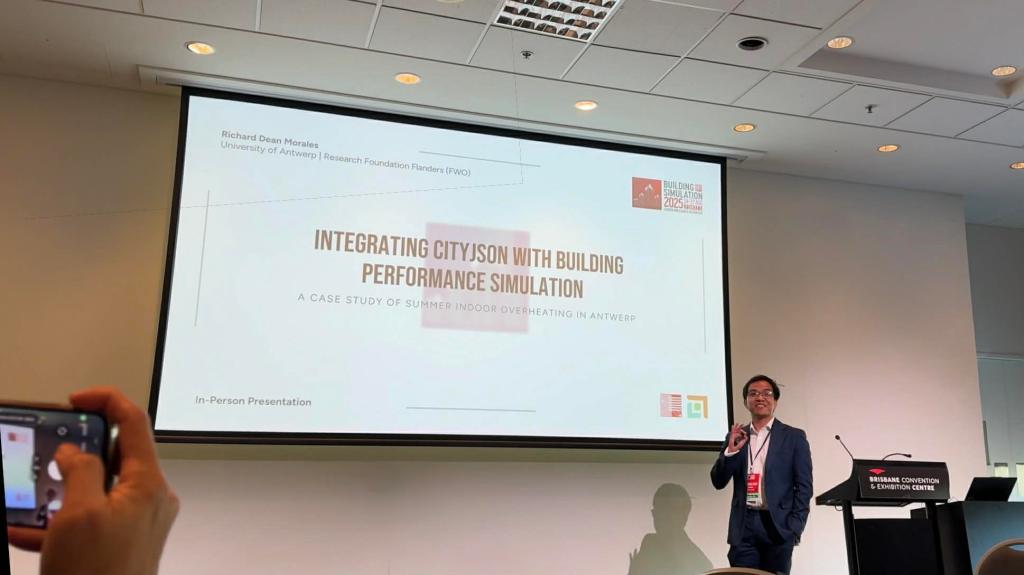
During the conference, Richard presented his latest paper, "Integrating CityJSON with building performance simulation: A case study of summer indoor overheating in Antwerp," co-authored with Prof. Dr. Ir. Amaryllis Audenaert and Prof. Dr. Ir. Stijn Verbeke.
The Research: Context Matters
As cities densify, accurately predicting indoor overheating is crucial for health and comfort. However, current urban modelling often relies on simplified archetypes or simulates buildings in isolation, ignoring the complex thermal reality of dense neighborhoods.
In this study, the team introduced a comprehensive toolchain that translates detailed CityJSON geometries directly into EnergyPlus input files. This allowed for a direct comparison between simulating buildings as isolated units versus simulating them collectively at an urban scale.
Key Findings Shared at the Conference
The results presented at BS2025 highlighted a critical discrepancy in how we assess overheating risk:
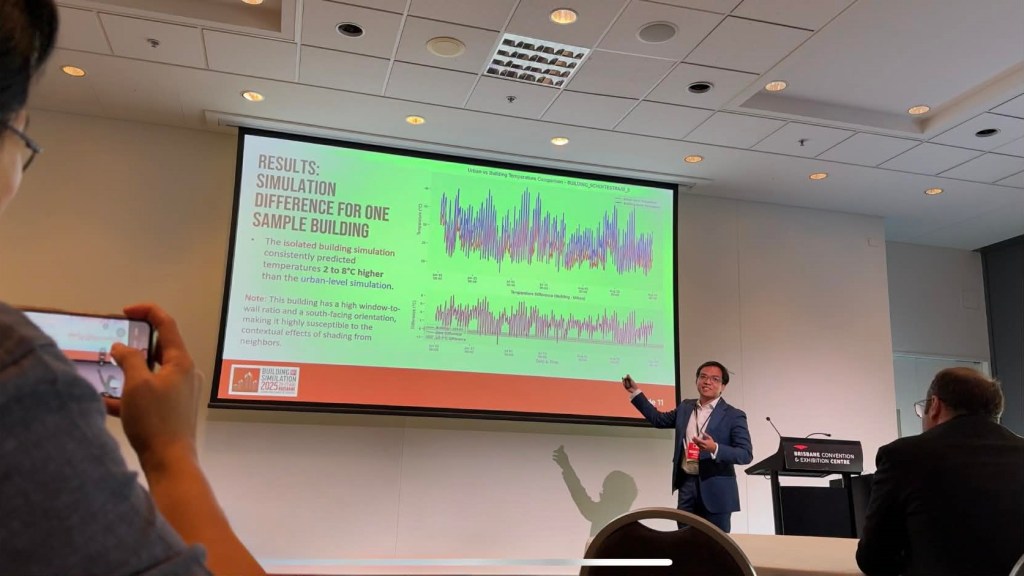
- The "Isolation" Bias: The study revealed that simulating buildings in isolation consistently resulted in higher predicted temperatures compared to urban-scale simulations.
- The Cause: Isolated models typically treat adjacent walls as adiabatic (no heat transfer). In reality, buildings in dense rows constantly exchange heat with their neighbors.
- The Impact: Neglecting these interactions can lead to an overestimation of overheating risks, particularly for buildings with high window-to-wall ratios.
Moving Forward
This research, conducted with the support of the Research Foundation Flanders (FWO), suggests that to create effective mitigation strategies for climate change, we must move toward geometry-specific, urban-aware modelling.
For those interested in the technical workflow involving CityJSON or the detailed statistical analysis of the temperature discrepancies, the full conference paper is now available via the link above.