Official Article Link: https://doi.org/10.1016/j.buildenv.2024.112363
Addressing the growing challenge of indoor overheating in our cities requires a deeper, more integrated approach to building simulation. While the Urban Heat Island (UHI) effect is a known driver of outdoor heat stress, its translation to the indoor environment is far from straightforward, influenced by a complex interplay of microclimate, building design, and occupant actions.
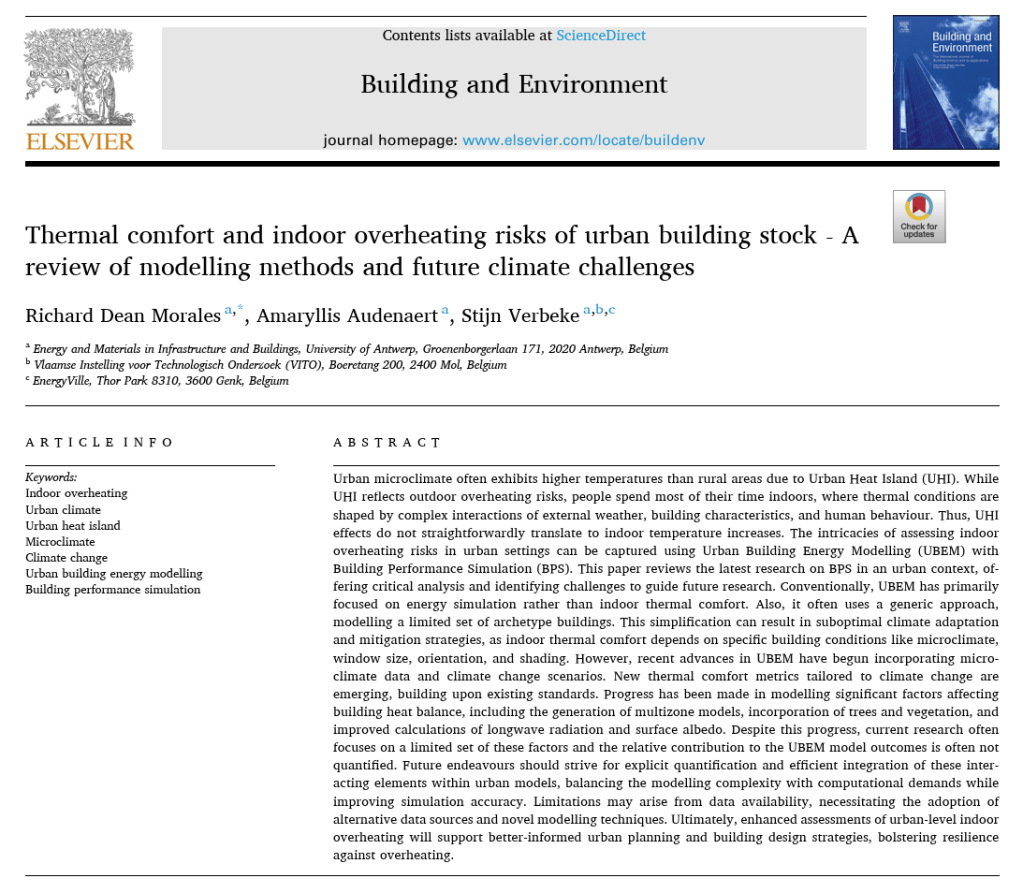
To that end, my recent review paper, “Thermal comfort and indoor overheating risks of urban building stock – A review of modelling methods and future climate challenges,” has now been published in the journal Building and Environment. This work is developed with Prof. Dr. Ir. Amaryllis Audenaert and Dr. Ir. Stijn Verbeke, both from the University of Antwerp. The research study offers a systematic synthesis of the methods available for tackling this issue at scale.
The Core Challenge: From Outdoor Climate to Indoor Risk
A central theme of this paper is the critical gap between large-scale urban climate assessment and detailed indoor thermal comfort analysis. Urban Building Energy Modelling (UBEM) has traditionally focused more on energy consumption than on the granular, zone-specific conditions that determine occupant comfort. This review examines the limitations of that approach and surveys the advanced methods needed for a more reliable assessment of overheating risk.
A Synthesis of Modelling Approaches
The paper is structured to guide a reader through the key components of a robust urban overheating risk assessment framework. It provides a critical examination of:
- Outdoor Boundary Conditions: We review methodologies for generating the weather data that drives simulations, including techniques to incorporate both the U.H.I. effect and projections from future climate change scenarios.
- Indoor Overheating Criteria: The work synthesizes the various metrics used for evaluation, from static and adaptive comfort criteria found in standards like CIBSE and ASHRAE to newer, climate-sensitive indices such as the Indoor Overheating Degree (IOD).
- Advanced Urban Building Modelling: The review details essential enhancements to UBEM needed for accurate thermal comfort simulation. Key areas of focus include:
- The necessity of multi-zone models over simplified single-zone archetypes to capture temperature variations within a building.
- The significant impact of longwave radiation exchange between buildings, a factor often oversimplified in standard simulation practice.
- The integration of surrounding trees, vegetation, and surface albedo, which collectively alter the microclimate and a building’s thermal balance.
A Resource for Researchers and Practitioners
This publication was designed to serve two key audiences in the field of building performance:
- For Researchers: It provides a comprehensive map of the current literature and clearly identifies research gaps, particularly in the integration of multi-physics models and the need to quantify the relative importance of different modelling factors. It is intended to be a foundational resource for developing the next generation of UBEM tools.
- For Practitioners: For architects, engineers, and urban planners, the paper highlights the practical limitations of conventional modelling. It makes the case for moving beyond standard assumptions to incorporate detailed microclimatic data and surrounding urban context, leading to more resilient and better-informed design strategies.
Accessing the Publication
The full paper is available from the publisher, Building and Environment. As it is published under a subscription model, access is available via the official DOI link. Your institution may provide direct access.
Official Article Link: https://doi.org/10.1016/j.buildenv.2024.112363
This work was supported by the Research Foundation Flanders (FWO) through the CHIASMUS project and my PhD Fellowship. My hope is that it serves as a valuable resource and encourages further investigation into these critical challenges.
 Richard Dean Morales